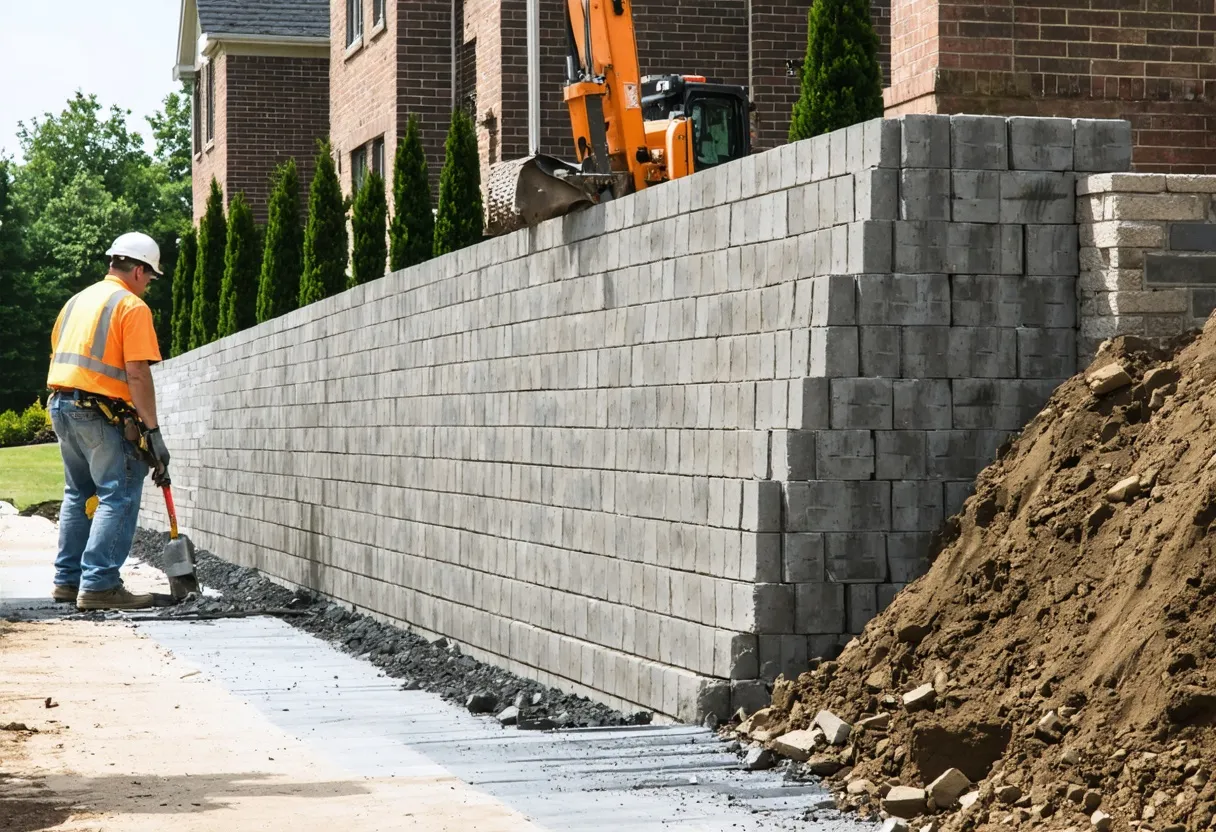
Drive through almost any Jefferson County subdivision built after 1960 and you'll see it: a house sitting on a shelf cut into a hillside, with a slope rising or dropping away on at least one side of the lot. Birmingham sits inside the Ridge and Valley region, and that terrain is exactly why retaining walls aren't a landscaping luxury here — they're load-bearing infrastructure holding back graded soil that would otherwise erode, slide, or eventually undermine a driveway, patio, or foundation footing.
We build and repair concrete retaining walls across the Birmingham area with a published price range, a written workmanship warranty, and financing on the table before you ever sign anything. No verbal ballpark, no mystery change orders once excavation starts. If you're staring at a bowing block wall, an eroding backyard slope, or a driveway that needs a wall to support it, this page walks through what actually goes into building one that holds — and what it costs to get it right.
Signs a Birmingham Slope Is Ready to Fail
How We Design and Build a Retaining Wall in Birmingham
We measure the slope, check drainage patterns, and evaluate Jefferson County's clay-heavy soil for load and expansion before recommending a wall type.
You get a specific, itemized price for poured concrete, block, or a terraced design — whichever actually fits the height, length, and load, not a default upsell.
We excavate to proper depth, compact the base, and install perforated drain pipe and gravel backfill before a single course goes up, since drainage failure is the leading cause of wall collapse.
Forms are set and concrete is poured, or block is laid course by course with steel reinforcement sized to the engineered load, then backfilled in compacted lifts to prevent future settling.
We grade the top of the wall for proper runoff, finish the face to your specification, and review the written warranty with you before closing out the job.
What a Retaining Wall Costs in Birmingham
We publish real numbers instead of making you sit through a sales pitch to hear a price. Homeowners in our market typically land somewhere between $25 and $75 per square foot of wall face for a properly built concrete or block retaining wall, with taller engineered walls or heavily stamped and colored finishes running toward the higher end of that range. Every estimate is free, written, and itemized before any excavation begins.
What moves the price up or down
- Wall height — taller walls need deeper footings and more reinforcement, and often trigger engineering review.
- Material choice — poured concrete costs more upfront than modular block but handles heavier loads with less long-term maintenance.
- Drainage complexity — sites with heavier water flow behind the wall need more extensive drain systems.
- Site access — tight backyards that require hand-digging or small equipment cost more than open, machine-accessible lots.
- Excavation volume — the amount of dirt that has to be cut and hauled affects both labor time and disposal cost.
- Permitting and engineering — walls generally over about four feet require stamped drawings and a permit in most Jefferson County jurisdictions.
Financing is available for larger retaining wall and drainage projects, so a slope that's actively eroding or a wall that's already failing doesn't have to sit and wait for the full budget to come together.
Written Warranty, Real Pricing, No Surprises
Every wall we build comes with a written workmanship warranty and a detailed, itemized estimate you can read before you decide anything. We're based on 31st Street N in Birmingham, and we mean it when we say the price we quote is the price you pay.
Why Retaining Walls Fail in Jefferson County's Red Clay
Most of the retaining wall calls we get aren't new installs — they're repairs to walls that were built wrong the first time. Jefferson County's clay-heavy soil holds water and expands and contracts more than sandy or loamy soil, which means a wall built without the right footing and drainage plan here fails faster than the same wall would somewhere with better-draining ground.
The failures we see over and over trace back to a small handful of causes: no footing or an undersized one, missing or blocked drain lines that trap water and add hydrostatic pressure behind the wall, backfill that was dumped instead of compacted in lifts, and reinforcement that wasn't sized for the actual soil load. Every one of those is a workmanship problem, not a material problem — which is exactly why the contractor pouring or laying your wall matters more than the brand of block or bag of concrete going into it.
When a wall is salvageable, we repair it — rebuilding drainage, underpinning a footing, or replacing a damaged section. When the footing itself has failed, repair is a temporary fix at best, and we'll tell you honestly during the site evaluation which situation you're actually in before you spend money on the wrong solution.
Retaining Wall Questions Birmingham Homeowners Ask
How tall can a retaining wall be before Jefferson County requires a permit?
Requirements vary by jurisdiction, but many areas require a permit and stamped engineering drawings once a wall exceeds roughly four feet, or shorter if it's supporting a driveway or structure. We check the specifics for your property and handle the permitting.
How long does a retaining wall installation actually take?
A smaller wall under three feet with moderate length can often be finished in a few days including drainage and grading. Taller or longer walls requiring engineering approval and permits typically run one to three weeks depending on size and permitting timelines.
Does Birmingham's mild winter affect when a wall can be built?
Not much. Because hard freezes are infrequent here, we're able to excavate, pour, and cure concrete retaining walls across most of the year without the scheduling gaps or freeze-thaw cracking risk that colder climates deal with.
Can you repair a leaning wall instead of tearing it out?
Often, yes, if the footing is sound and the problem is limited to drainage or a section of the face. If the footing has failed, replacement is usually the more cost-effective long-term fix, and we'll walk you through which situation you're in.
What happens if my wall is actively bulging or collapsing right now?
A wall in active failure is a safety issue, not something to schedule for next month. We treat failing retaining walls with the same rapid-response standard we apply to foundation repair emergencies — call and we'll get a crew assessing the site right away.
Where We Build Retaining Walls Across Central Alabama
We're a locally based concrete contractor operating out of Birmingham on 31st Street N, and retaining walls are one of the most common calls we get from homeowners on the hillside lots scattered throughout Jefferson County. That includes graded and terraced properties around Vestavia Hills, Mountain Brook, Hoover, and Homewood, as well as sloped lots out toward Trussville, Fultondale, Hueytown, and Bessemer.
Wherever the lot sits, the same principles apply: a footing sized for the actual soil load, drainage engineered for the site rather than bolted on as an afterthought, and a written estimate you can read before deciding anything. If you're planning a new wall, watching an existing one lean, or dealing with a slope that keeps losing topsoil every time it rains, get a free written estimate first — we'll evaluate the site, recommend the right wall type, give you an upfront price range and warranty in writing, and walk you through financing if the wall needs to go in now rather than later.
Free, No-Obligation Quote
See your price range in writing before you decide on anything.
Get Your Written Quote
Tell us about the crack, the heave, or the slab, and a local crew will get back to you the same day.